 Dream
Recall Techniques: Dream
Recall Techniques:
Remember more Dreams
The main barrier to dream recall and to lucid
dreaming (realizing during a dream that one is dreaming) is
that waking and dreaming memory aren't connected nearly as well
as they could be with greater intention, practice and focus. Making
a consistent effort to remember and record your dreams will help
your waking mind to ally itself more closely with your dream experience.
It's also an excellent way to increase imagination, creative and
intuitive capabilities which are all intimately connected with dreams.
This alone should provide strong incentive.
- YOU'VE GOT TO WANT IT. First and foremost, you must
feel that it will be useful to you, if not extremely valuable.
Without this, motivation will soon disappear. More importantly,
the desire acts as a magnet which draws your dreams into memory.
- IT'S A MATTER OF FOCUS AND ATTENTION. Understand that
dream recall is an inherent, natural human trait. That is why
young children are usually in touch with dreams, as are some
native cultures who share their dreams with each other daily.
Dream recall is a bit like a mental muscle, the more you use
it, the stronger it becomes. Without exercise it may shrink,
but it is there if you decide to work it out again. So if your
recall is poor, trust that it will come in time, and the trust
alone will actually help.
- BEDTIME PRACTICE: Before sleep, reread your
dreams from the previous (or more) night(s). This allows you
to begin to connect with your dream memory, and is also an opportunity
to interpret your dreams and spot connections to the day's events.
Then, as you go to bed, clearly ask (rather than command) yourself
to remember your dreams when you awaken in the morning or during
the night, and remind yourself that it's a simple, natural process.
Also, suggest to yourself that you will spontaneously awaken
when you need to without using an alarm clock, since
it can inhibit recall. This method works well with practice,
but you may initially wish to set your alarm for 15 minutes
after your suggested wake-up time, just to be safe. Any time
you awaken, keep your eyes closed (or shut them if already open)
and remain as motionless as possible. If you moved since waking,
return to your earlier body position. Gather as many images,
feelings or impressions as you can, then rise and immediately
record them in a journal (which you keep nearby on a nightstand)
or say them
into a tape recorder, no matter how brief or vague they may
at first seem. You'll be surprised at how much more you
can remember as you write (or speak).
If your next day's schedule allows for the possibility of slightly
less alertness and you're game to try something a bit more adventurous,
try drinking one or more glasses of water before bed so that
your body will automatically awaken you during the night - quite
likely just after a dream cycle is just complete. This requires
a little more dedication but has it's pay-offs since it gives
your waking and dreaming states of mind more opportunity to
overlap, and hence triggers better dream recall.
- ENVISION. A few times during the first few weeks of focusing
on increasing your recall, take a quiet/meditative moment and
imagine your dream journal's pages filled
with many written down dreams, and even accompanying drawings, images,
and other notes that you've added about them. See this as
clearly as you can in your mind's eye and make sure to
feel pleased that your
dream recall is very good and still growing even better.
- BE PLAYFUL, PATIENT, and PERSISTENT. Although
most people start having success the first week or two, dream
recall is a mental muscle which may require some time to get
back into shape. Try to maintain a relaxed and playful attitude
of looking forward to your dreams while being willing to let
them come all in good time. Trying too hard or being too serious
can be limiting factors. Dream recall and motivation tend to
come and go naturally in cycles, and also depend upon what else
is going on in your life. Once you start on a cycle of focusing
on recall, stick with it for at least a few days, because
consecutive nights can have an additive effect.
- A WEEKLY
STUDY GROUP with a shared interest in dreams is unmatchable
for sustained motivation and inspiration.
Pen that Lights up Aids Recall by Allowing You to Write Your Dreams in The Dark
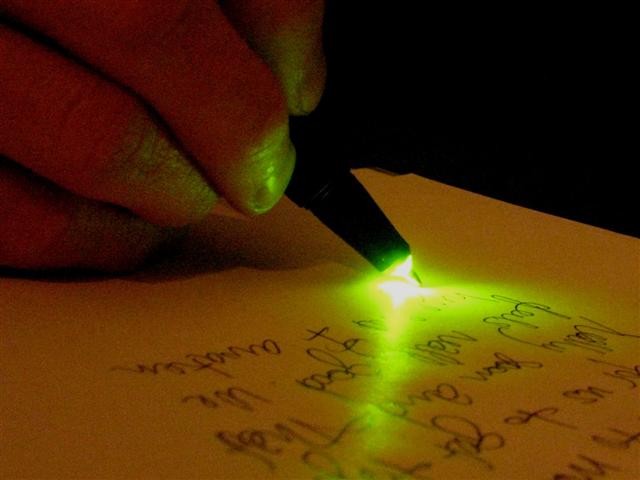 This nifty little gadget lights up to help you record your dreams and creative inspirations at night or during early
morning hours while it is still dark. It can help improve your recall since you don't have to move to turn
on the bedside lamp which often disturbs not just the delicate memories of any dreams you were
just having, but also your partner if you sleep with someone.
This nifty little gadget lights up to help you record your dreams and creative inspirations at night or during early
morning hours while it is still dark. It can help improve your recall since you don't have to move to turn
on the bedside lamp which often disturbs not just the delicate memories of any dreams you were
just having, but also your partner if you sleep with someone.
The 2 button cell batteries (included) will last a year or two of normal use, and
are easily replaceable and available at most pharmacies, as is the ink cartridge
should it ever run out.
A great little item for the price and makes a terrific gift.
To order using paypal or credit card, click the button below.
|

